Blogs
We share with you the latest industry trends, try to solve all your questions about flexible packaging machines and printing machines as well. Read our blogs to keep abreast of what’s new in the industry and in Zonbon.

Razor slitting, shear slitting, and crush cutting are three widely used methods for converting wide rolls into narrower finished rolls. Each method cuts material differently, which means the correct choice depends on much more than machine speed or knife type.
For global buyers, the most important question is not which slitting method is universally better. It is which cutting method best matches the actual material structure, thickness, required edge quality, slit width, operating conditions, and downstream process.
Thin plastic films may perform well with razor or shear slitting, while paper, laminated materials, nonwovens, and thicker roll materials can require different cutting characteristics. Selecting an unsuitable knife system can lead to poor edges, dust, material deformation, unstable production, or excessive blade wear.
This article compares razor, shear, and crush slitting from a buyer's perspective and explains how each method works, where it is commonly used, and what should be confirmed before selecting a slitting machine configuration.
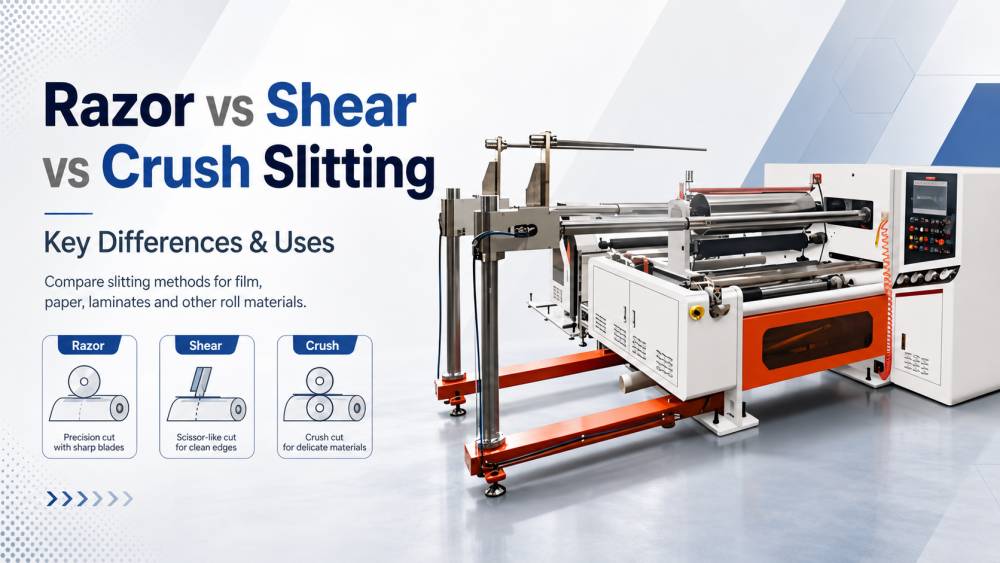
The following comparison provides a practical starting point. It should not be treated as a universal rule because actual suitability depends on the material structure and production requirements.
| Slitting Method | How It Cuts | Commonly Considered For | Main Strength | Main Buyer Concern |
|---|---|---|---|---|
| Razor Slitting | A sharp blade penetrates and separates the moving web | Thin films and suitable flexible materials | Simple cutting structure and clean cutting for suitable films | Blade suitability, film thickness and edge quality |
| Shear Slitting | Upper and lower circular knives cut with a scissor-like action | Paper, films, laminates and precision converting applications | Controlled cutting and consistent edge quality | Knife setup, overlap, side load and alignment |
| Crush Cutting | A knife presses the material against a hardened support surface | Suitable thicker, fibrous or compressible materials | Robust cutting action and relatively simple setup | Edge deformation, dust and suitability for the material |
There is no single "best" slitting method for every application. A buyer processing thin BOPP film, kraft paper, a multilayer laminate, adhesive material, or nonwoven fabric may require completely different cutting conditions even when the finished roll widths are similar.
Razor slitting uses a very sharp blade positioned in the path of the moving web. As the material travels through the slitting section, the blade penetrates the web and separates it into narrower strips.
Because the cutting mechanism is relatively simple, razor slitting is commonly considered for suitable thin and flexible materials where a clean cut can be achieved without the additional upper-and-lower knife geometry required by shear slitting.
Razor slitting is frequently evaluated for thin plastic film applications, including suitable grades of BOPP, PET, and other flexible webs. Actual suitability depends on film thickness, stiffness, coating, lamination structure, operating speed, and required edge quality.
Thin plastic films
Flexible packaging films
Selected BOPP and PET applications
Suitable single-layer flexible materials
Simple cutting principle: the blade directly penetrates the moving material.
Suitable for many thin films: when the material structure and thickness are appropriate.
Relatively simple blade replacement: useful in production environments requiring routine knife maintenance.
Potential for efficient operation: when the film remains stable and the blade produces the required edge quality.
Razor slitting should not be selected simply because the material is described as "film." Buyers should confirm whether the blade can maintain acceptable edge quality across the complete production range.
Important questions include:
What is the minimum and maximum film thickness?
Is the material single-layer, coated, metallized, printed, or laminated?
What slit width and tolerance are required?
What production speed must be maintained?
Will the blade create unacceptable edge damage or debris?
How frequently will blades require inspection or replacement?
Shear slitting uses two circular knives: an upper knife and a lower knife. The knives overlap slightly and cut the web with a scissor-like action as the material passes through the cutting section.
Unlike razor slitting, shear slitting performance depends heavily on the relationship between the two knives. Knife overlap, side load, alignment, sharpness, and positioning all influence cutting quality.
Shear slitting is widely used in converting applications requiring controlled cutting and consistent edges. Depending on machine design and material characteristics, it can be suitable for paper, films, laminated materials, and other roll products.
Paper and packaging paper
Plastic film applications
Laminated packaging structures
Materials requiring controlled slit edges
Applications where cutting accuracy is important
Controlled cutting action: the upper and lower knives work together like scissors.
Good edge quality: when knife geometry and setup are correctly matched to the material.
Broad application range: suitable for many paper, film, and laminate applications.
Precision capability: useful where finished roll width and edge consistency are important.
A shear slitting system can use high-quality knives and still produce poor results if the setup is incorrect. Buyers and operators should understand that knife condition alone does not determine performance.
| Setup Factor | Why It Matters |
|---|---|
| Knife Overlap | Incorrect overlap can affect cutting stability and blade life. |
| Side Load | Excessive or insufficient contact can influence edge quality and wear. |
| Knife Alignment | Poor positioning can lead to inconsistent cutting. |
| Blade Sharpness | Worn knives may increase dust, burrs, or poor edges. |
| Material Tension | Unstable web movement can reduce the benefit of accurate knife setup. |
Crush cutting uses a knife or cutting wheel that presses the material against a hardened anvil or support surface. Instead of slicing through the web with two overlapping knives, the material is separated through concentrated pressure.
This cutting principle can be useful for suitable thicker, fibrous, compressible, or industrial roll materials, but it is not automatically appropriate for thin films or applications requiring extremely clean edges.
Crush cutting is often evaluated for applications where the material can tolerate pressure-based separation and where the required edge characteristics are compatible with the process.
Selected paper products
Nonwoven materials
Thicker or compressible webs
Specialty industrial roll materials
Actual suitability depends on the material structure, density, thickness, coating, and downstream product requirements.
Robust cutting principle: suitable for materials that respond well to pressure-based cutting.
Relatively straightforward setup: depending on machine configuration.
Useful for selected thicker materials: where razor or shear cutting may not be the preferred solution.
Applicable to certain fibrous or compressible webs: subject to material testing and edge-quality requirements.
Because crush cutting separates material through pressure against a support surface, buyers should carefully evaluate whether this process affects finished edge quality.
Potential concerns include:
Edge compression or deformation
Dust or debris with some materials
Wear of the cutting wheel or support surface
Limited suitability for films requiring very clean edges
Possible effects on coated or sensitive material structures
The most useful way to compare razor, shear, and crush slitting is not to ask which method is technically superior. Instead, buyers should ask a different question for each method.
| Method | Key Buyer Question |
|---|---|
| Razor Slitting | Can a blade produce the required edge quality on this film at the required thickness and speed? |
| Shear Slitting | Will a controlled upper-and-lower knife system provide the precision and edge consistency this material requires? |
| Crush Cutting | Can this material tolerate pressure-based cutting while still meeting the finished edge requirement? |
Once these basic differences are understood, the next step is to match the cutting method to the actual material rather than selecting the knife system from a general machine specification.
Material type is one of the first factors to consider when choosing between razor, shear, and crush slitting, but the material name alone is not enough to make the final decision. Thickness, stiffness, coating, lamination structure, stretch behavior, required edge quality, slit width, and downstream use can all change which cutting method is most suitable.
The following matrix provides a practical starting point for buyers comparing slitting methods. It shows which technologies are commonly evaluated for different roll materials rather than defining a universal rule for every application.
| Material | Razor Slitting | Shear Slitting | Crush Cutting | Main Selection Concern |
|---|---|---|---|---|
| BOPP Film | Commonly considered | Commonly considered | Generally not the first choice | Film thickness, edge quality, slit width and speed |
| PET Film | Commonly considered for suitable thin films | Commonly considered | Generally not the first choice | Thickness, stiffness and required edge quality |
| PE Film | Application-dependent | Commonly evaluated | Generally not the first choice | Stretch behavior, tension and edge quality |
| CPP Film | Application-dependent | Commonly evaluated | Generally not the first choice | Film structure, thickness and web stability |
| Laminated Film | Application-dependent | Frequently evaluated | Depends on laminate structure | Layer structure, total thickness, stiffness and edge requirement |
| Paper | Limited / application-dependent | Commonly used | Commonly used for suitable applications | Paper grade, thickness, dust and finished edge quality |
| Nonwoven | Application-dependent | Application-dependent | Commonly evaluated for suitable structures | Density, thickness, fiber structure and edge requirement |
| Adhesive Materials | Depends on construction | Depends on construction | Depends on construction | Adhesive layer, face material, liner and finished product |
The matrix should be used as a screening tool rather than a final machine specification. When the material is difficult to classify or the finished edge requirement is demanding, representative material testing is more reliable than selecting the knife system from the material name alone.
Both razor and shear slitting can be considered for BOPP film, depending on film thickness, slit width, required edge quality, machine design, and production conditions.
Razor slitting is often attractive for suitable thin BOPP films because of its relatively simple cutting action. Shear slitting may be considered when the application requires a controlled cutting action or when the material and finished-roll specification are better matched to an upper-and-lower knife system.
Before deciding between the two, buyers should confirm:
Minimum and maximum BOPP thickness
Whether the film is plain, printed, coated, or metallized
Required slit widths and tolerances
Expected production speed
Required finished edge quality
Number and dimensions of finished rolls
The correct choice should be based on the required production result rather than assuming that all BOPP applications use the same knife system.
Razor and shear slitting are both commonly evaluated for PET film. The final choice depends on thickness, stiffness, coating, surface treatment, slit width, and the edge quality required by the next production process.
Thin PET films may be suitable for razor slitting under appropriate conditions, while shear slitting provides another option when controlled knife engagement and consistent edge formation are important.
Buyers should also distinguish between plain PET and more specialized structures. Printed PET, coated PET, metallized PET, and PET used as one layer of a laminate may require different cutting conditions even when the base polymer is the same.
PE film can be more stretch-sensitive than dimensionally stable films such as PET. This means knife selection cannot be separated from web tension and material support during cutting.
If the film stretches, wrinkles, or moves around the cutting point, even a suitable knife can produce inconsistent results. Shear slitting is commonly evaluated for many PE applications, while razor slitting may also be suitable for particular film structures and thicknesses.
For PE film, buyers should evaluate the complete combination of:
Film thickness
Stretch behavior
Web tension
Knife geometry
Required slit width
Finished edge quality
This is why asking only "Which knife is best for PE?" does not provide enough information for reliable machine selection.
CPP film is another flexible packaging material for which razor or shear slitting may be evaluated depending on the actual application. Thickness, web behavior, surface condition, and finished roll requirements should all be considered.
If CPP is part of a multilayer packaging structure rather than a standalone film, the complete laminate should be evaluated because the other layers can change stiffness, cutting resistance, and edge behavior.
For this reason, buyers should provide the complete material specification instead of identifying the web only as "CPP" when requesting a slitting machine recommendation.
There is no single cutting method that is automatically best for every laminated film. A laminate combines multiple layers, and those layers can create different stiffness, thickness, friction, and cutting characteristics from a single-layer film.
For example, flexible packaging structures may combine PET, BOPP, PE, CPP, metallized film, aluminum foil, paper, or other layers. Two materials described simply as "laminated film" can therefore behave very differently during slitting.
Shear slitting is frequently evaluated for laminated materials where controlled cutting and edge consistency are important, while razor or other cutting configurations may remain suitable for particular laminate structures.
Before selecting the knife system, provide:
Complete layer structure
Total material thickness
Individual layers when known
Whether the material is printed, coated, or metallized
Minimum required slit width
Required edge quality
Expected production speed
Shear and crush cutting are both used in paper converting, but they produce the cut through different mechanisms and should not be treated as interchangeable solutions.
Shear slitting uses circular knives to create a controlled scissor-like cut and is widely considered where edge quality and accurate slitting are important. Crush cutting presses the material against a hardened support surface and can be suitable for particular paper grades and converting requirements.
| Buyer Requirement | What to Evaluate |
|---|---|
| Clean finished edges | Compare actual shear and crush cutting results on the paper grade |
| Dust-sensitive production | Evaluate debris generated by the cutting process |
| Thicker paper | Confirm knife geometry and material suitability |
| High-volume production | Compare stable speed, knife life and setup requirements |
| Downstream printing or converting | Confirm whether the finished edge meets the next process requirement |
Paper grade is important. Kraft paper, coated paper, release paper, printing paper, specialty paper, and other products should not automatically be assigned the same cutting configuration.
Nonwoven materials can vary significantly in thickness, density, fiber structure, softness, and compressibility. Crush cutting may be considered for suitable nonwoven applications because of its pressure-based cutting action, while shear or other cutting methods may be more appropriate for different structures.
The finished edge is especially important. A cutting method that separates the material successfully may still be unsuitable if it creates excessive fiber deformation, loose fibers, dust, or an unacceptable edge appearance.
For nonwoven applications, representative material testing is particularly useful when the supplier has not previously processed the same structure.
Adhesive materials should be evaluated as a complete construction rather than as one base material. A typical adhesive product may include a face material, adhesive layer, release coating, and liner, each of which can affect cutting behavior.
Depending on the product, buyers may need to consider:
Face material type and thickness
Adhesive characteristics
Liner material and thickness
Whether adhesive builds up on the knife
Required finished edge quality
Whether the material is fully slit or processed in another converting format
For unfamiliar adhesive constructions, sample testing can help determine the suitable knife configuration and maintenance requirements before production.
Terms such as "PET film," "paper," or "laminated film" describe only part of the application. Two buyers can process materials with the same general name but require different slitting systems because their thickness, structure, slit pattern, speed, and finished product requirements are different.
A better selection process is:
| Step | Information to Define | Why It Matters |
|---|---|---|
| 1 | Material and complete structure | Identifies the basic cutting behavior |
| 2 | Thickness range | Affects blade selection and cutting conditions |
| 3 | Required slit widths | Influences knife arrangement and accuracy requirements |
| 4 | Required edge quality | Helps determine whether the cutting result is acceptable |
| 5 | Production speed | Confirms whether cutting remains stable under actual operating conditions |
| 6 | Downstream process | Defines what the finished edge must achieve after slitting |
Instead of asking a supplier only, "Which knife should I use for this material?", buyers can provide the complete production specification and ask which cutting method can consistently achieve the required finished result and why.
The material provides the starting point, but the final cutting decision should combine material behavior with the finished product requirement.
A practical selection path is:
Material Structure → Thickness → Required Slit Width → Edge Quality → Production Speed → Downstream Use → Cutting Method
This approach is more reliable than assigning razor, shear, or crush cutting according to material name alone. It also gives buyers a clearer basis for comparing machine configurations proposed by different suppliers.
Material compatibility is only the first step when choosing between razor, shear, and crush slitting. In many applications, more than one cutting method can physically separate the web, but that does not mean each method will provide the same finished edge, production stability, maintenance requirement, or downstream performance.
For buyers, the better comparison is therefore not simply "Can this method cut my material?" but "Can it produce the required finished result consistently under my actual production conditions?"
| Comparison Factor | Razor Slitting | Shear Slitting | Crush Cutting |
|---|---|---|---|
| Typical Cutting Action | Direct blade penetration | Scissor-like cut between upper and lower knives | Pressure against an anvil or hardened surface |
| Thin Material Capability | Strong option for many suitable thin films | Strong option when the web and knife setup are suitable | Usually not the first choice for delicate thin films |
| Edge Quality | Can provide clean edges on suitable films | Can provide highly controlled edges with correct setup | Depends strongly on material response to compression |
| Setup Complexity | Relatively straightforward | Requires accurate knife positioning and engagement | Relatively straightforward, but pressure must suit the material |
| Blade Wear | Blade condition directly affects cutting quality | Knife geometry, alignment and wear all require attention | Cutting wheel and anvil condition require monitoring |
| Dust / Debris | Material-dependent | Can be controlled with correct setup and sharp knives | Can be an important consideration for fibrous or paper materials |
| Best Selection Basis | Film behavior and required edge quality | Precision, material structure and edge requirements | Material compressibility and acceptable edge characteristics |
These differences are general selection considerations rather than fixed performance guarantees. Machine design, blade quality, operator setup, material condition, web tension, and production speed can significantly affect the actual result.
A slitting method should not be judged only by whether it can separate the web. The condition of the finished edge can influence rewinding, printing, laminating, coating, bag making, labeling, and other downstream processes.
Depending on the material and application, buyers may need to evaluate:
Burrs or rough edges
Film deformation near the slit
Fiber damage on paper or nonwoven materials
Dust or loose particles
Layer separation on laminated structures
Adhesive contamination around the cutting area
Consistency between multiple slit positions
An edge that appears acceptable during a short machine demonstration may still create problems when the finished roll enters the next production process. This is why downstream use should be defined before the cutting system is finalized.
There is no universal answer because edge quality depends on both the cutting method and the material. Razor slitting can produce clean edges on suitable thin films, while correctly configured shear slitting can provide controlled edges across many film, paper, and laminate applications. Crush cutting may be appropriate for selected materials where pressure-based separation produces an acceptable finished edge.
For applications with strict edge requirements, the most reliable comparison is to test the actual material using the proposed knife configuration and inspect the finished rolls under representative production conditions.
Cutting dust is more than a housekeeping issue. Loose fibers, particles, or material debris can contaminate finished rolls, accumulate around machine components, and create problems in downstream printing, coating, laminating, or other converting processes.
Dust generation depends on the material as well as the cutting method. Paper grade, fiber structure, coating, blade sharpness, knife pressure, and cutting speed can all influence the result.
| Observed Problem | What Buyers Should Investigate |
|---|---|
| Excessive paper dust | Knife sharpness, cutting method, pressure and paper structure |
| Loose fibers | Material structure and cutting action |
| Film particles or damaged edges | Blade condition, film structure and knife setup |
| Adhesive buildup | Adhesive construction, blade surface and cleaning requirements |
| Increasing debris during production | Knife wear and maintenance interval |
Yes, production speed can influence cutting performance, but the relationship is not simply "faster is worse" or "faster is better." The practical limit depends on material stability, knife condition, cutting geometry, web tension, vibration, slit width, and rewinding performance.
A slitting machine may have a high maximum mechanical speed while the actual material requires a lower operating speed to maintain acceptable edge quality and finished roll consistency.
When evaluating cutting performance at higher speeds, buyers should observe:
Whether slit edges remain consistent
Whether the web remains stable around the cutting section
Whether dust or debris increases
Whether narrow slit widths remain accurate
Whether vibration affects knife performance
Whether finished rolls remain stable during rewinding
The useful specification is therefore not only maximum machine speed, but the stable production speed at which the required cutting and finished-roll quality can be maintained.
Slitting knives are wear components. As the cutting edge deteriorates, production quality can gradually change even when the machine settings remain the same.
Depending on the cutting method and material, worn knives may contribute to:
Rough or inconsistent slit edges
Higher dust generation
More cutting force or pressure
Material deformation
Reduced stable operating speed
More frequent production adjustments
For this reason, buyers should evaluate knife maintenance and replacement as part of the machine's normal operating requirements rather than treating blades as a minor spare part.
There is no reliable universal replacement interval for slitting knives. Blade life depends on the knife material, web material, thickness, coating, operating speed, cutting pressure, knife setup, production volume, and required edge quality.
Instead of replacing knives according to one fixed number of operating hours, buyers should establish inspection and replacement criteria based on measurable changes such as edge deterioration, increasing dust, visible blade damage, or declining cutting consistency.
A cutting system that performs well during a factory demonstration must also remain practical during months and years of production. Buyers should understand what routine work operators and maintenance teams will need to perform.
| Maintenance Item | Razor | Shear | Crush |
|---|---|---|---|
| Cutting Edge Inspection | Regular blade inspection | Regular upper and lower knife inspection | Regular cutting wheel inspection |
| Alignment / Setup | Blade positioning | Overlap, side load and knife alignment | Knife position and cutting pressure |
| Supporting Surface | Depends on machine design | Lower knife condition is important | Anvil or hardened surface condition is important |
| Cleaning | Material-dependent | Material-dependent | Material-dependent |
| Spare Parts Planning | Replacement blades | Upper/lower knives and related components | Cutting wheels and wear-related components |
Before ordering, buyers can ask the supplier for the recommended spare knife quantity, sharpening or replacement procedure, common wear components, and operator training requirements for the selected cutting system.
Factories producing many roll widths should consider how often knife positions need to be changed. A cutting system may provide excellent performance but still reduce overall production efficiency if every order change requires a long manual setup.
When frequent slit-pattern changes are expected, buyers should evaluate:
How knives are repositioned
How slit width is measured and confirmed
How long a typical changeover takes
Whether knife holders are easy to access
Whether positioning assistance or automatic knife positioning is available
How much setup material is normally required before stable production begins
This is especially important for converters serving multiple customers with short production runs and frequently changing finished-roll specifications.
A common equipment-selection mistake is to choose a cutting method from the raw material alone. In practice, the finished roll and its next production step can be just as important as the material being slit.
For example, the same general roll material may be converted for printing, laminating, bag making, coating, labeling, packaging, or further precision converting. Each downstream process can place different requirements on edge quality, roll width, cleanliness, and winding consistency.
A better selection sequence is:
Finished Product → Downstream Process → Required Edge Quality → Material Structure → Slitting Method
| Downstream Requirement | Why Cutting Quality Matters |
|---|---|
| Printing | Web edges and roll stability can influence downstream web handling |
| Laminating | Damaged edges or contamination may affect subsequent converting |
| Bag Making | Consistent roll width supports stable downstream feeding and forming |
| Coating | Dust and damaged edges may create quality problems |
| Label Converting | Narrow-width accuracy and clean edges can become more important |
| Finished Roll Sale | Roll appearance, edge quality and width consistency directly affect customer acceptance |
Initial configuration cost is only one part of the cutting-system decision. A lower-cost setup can become more expensive in production if it creates excessive waste, frequent knife replacement, long changeovers, unstable edge quality, or repeated machine adjustments.
When comparing cutting systems, buyers should consider:
Knife and sharpening requirements
Expected maintenance workload
Setup and changeover time
Material waste during adjustment
Stable operating speed
Finished product rejection risk
Availability of replacement knives and wear parts
The most economical solution is usually the cutting system that can maintain the required product quality with a practical level of maintenance and operator intervention.
When two cutting methods both appear technically suitable, testing the actual material can provide a clearer basis for the final decision. The test should compare finished results rather than simply confirming that each method can cut through the web.
| Test Item | What to Check |
|---|---|
| Slit Edge | Cleanliness, deformation, burrs, loose fibers or layer damage |
| Width Consistency | Whether the required finished width can be maintained |
| Dust / Debris | Whether cutting generates unacceptable contamination |
| Web Stability | Whether the material remains stable around the cutting section |
| Operating Speed | Whether cutting quality remains acceptable at the intended production speed |
| Knife Condition | Whether the material creates unusual or rapid wear |
| Finished Rolls | Whether edge quality and width remain consistent after rewinding |
For expensive, coated, laminated, adhesive, unusually thin, or difficult-to-cut materials, this type of comparative test can reduce the risk of selecting a knife system that works in theory but performs poorly in actual production.
Razor, shear, and crush slitting should ultimately be compared by the production result they can deliver. Material compatibility identifies which methods may work, but edge quality, stable speed, dust generation, blade life, changeover requirements, and downstream performance determine whether the selected method is practical for long-term production.
A useful buyer decision process is:
Material Compatibility → Finished Edge Requirement → Stable Production Speed → Knife Life → Changeover & Maintenance → Downstream Performance → Final Cutting Method
Once these production factors are clear, buyers can discuss the knife system with a slitting machine manufacturer using measurable requirements instead of selecting razor, shear, or crush cutting from a general specification sheet.
Before confirming razor, shear, or crush cutting with a machine supplier, buyers should move beyond general questions such as "Can this machine slit my material?" The supplier should understand the complete material specification, finished product, and operating conditions before recommending a cutting system.
The following questions can help buyers evaluate whether a proposed knife configuration is based on the actual application:
| Question to Ask | Why It Matters |
|---|---|
| Which cutting method do you recommend for my material, and why? | Shows whether the recommendation is based on the application rather than a standard machine configuration. |
| What material structure and thickness range has this configuration processed? | Helps determine whether previous experience is relevant to your production. |
| Can the required minimum slit width be maintained? | Confirms whether knife arrangement and machine design match the finished product. |
| What edge quality should I expect? | Connects the cutting system with downstream production requirements. |
| What stable speed is realistic with my material? | Separates practical production capability from maximum mechanical speed. |
| How are knives positioned and adjusted? | Affects changeover time, operating convenience, and repeatability. |
| Which knife parts normally require sharpening or replacement? | Helps buyers plan maintenance and spare parts. |
| Can my actual material be tested before final acceptance? | Provides evidence when suitability cannot be confirmed from specifications alone. |
Yes, some slitting machines can be designed or configured to support more than one cutting method, but this capability should be confirmed for the specific machine rather than assumed. Whether razor, shear, and other knife systems can be combined depends on machine structure, knife stations, available space, web path, material range, and production requirements.
A multi-method configuration can be useful when one converter regularly processes materials with significantly different cutting requirements. However, buyers should not add multiple knife systems simply to make the machine specification look more versatile.
Before requesting more than one cutting method, consider:
How often each material will actually be produced
Whether one cutting method already covers most production
How long it takes to change between knife systems
Whether additional components increase setup complexity
Whether operators require additional training
Which spare knives and wear parts must be stocked
If several materials represent important production volumes and genuinely require different cutting characteristics, a flexible knife configuration may be valuable. If the secondary method will rarely be used, a simpler configuration may be more practical.
Yes, some slitting machines can be designed or configured to support more than one cutting method, but this capability should be confirmed for the specific machine rather than assumed. Whether razor, shear, and other knife systems can be combined depends on machine structure, knife stations, available space, web path, material range, and production requirements.
A multi-method configuration can be useful when one converter regularly processes materials with significantly different cutting requirements. However, buyers should not add multiple knife systems simply to make the machine specification look more versatile.
Before requesting more than one cutting method, consider:
How often each material will actually be produced
Whether one cutting method already covers most production
How long it takes to change between knife systems
Whether additional components increase setup complexity
Whether operators require additional training
Which spare knives and wear parts must be stocked
If several materials represent important production volumes and genuinely require different cutting characteristics, a flexible knife configuration may be valuable. If the secondary method will rarely be used, a simpler configuration may be more practical.
Sending only a small material sample without production specifications may not provide enough information for a meaningful test. Buyers should provide representative material together with the required finished-roll conditions.
Material name and complete structure
Minimum and maximum thickness
Whether the material is printed, coated, metallized, laminated, or adhesive
Parent roll dimensions when relevant
Required slit widths and tolerances
Finished roll requirements
Expected operating speed
Downstream application
Any known edge, dust, or cutting problems
If several materials will be processed, prioritize the most difficult material and the highest-volume production material rather than testing only the easiest sample.
The following matrix summarizes the main decision logic discussed throughout this article. It should be used to narrow the options before the final configuration is verified against actual material and production requirements.
| If Your Priority Is... | Method Commonly Worth Evaluating | What Must Still Be Confirmed |
|---|---|---|
| Slitting suitable thin flexible films | Razor or Shear | Thickness, film stability, edge quality and speed |
| Controlled precision cutting | Shear | Knife setup, material structure and required tolerance |
| Processing paper with demanding edge requirements | Shear | Paper grade, dust, knife life and downstream use |
| Pressure cutting of suitable thicker or compressible materials | Crush | Edge deformation, debris and material response |
| Processing laminated structures | Often Shear; application-dependent | Complete laminate structure, thickness and edge requirements |
| Frequently changing between different material families | Evaluate a flexible cutting configuration | Actual need for multiple systems, changeover time and complexity |
| Unfamiliar or difficult material | Do not decide from material name alone | Representative material test before final confirmation |
Not always. Razor slitting can work very well for suitable thin films, while shear slitting may provide better controlled cutting for other film structures and edge requirements. The correct choice depends on film type, thickness, slit width, tension behavior, speed, and required finished edge. For demanding applications, compare actual cutting results rather than selecting by film name alone.
Yes, some machines can support more than one cutting system. However, this depends on the machine structure and must be confirmed during configuration. A dual-method setup is most useful when both cutting systems will be used regularly for different materials. Buyers should also consider changeover time, operator training, additional components, and spare knife requirements.
No single method produces the cleanest edge for every material. Razor slitting can create clean edges on suitable thin films, while correctly configured shear slitting can provide highly controlled edges for many films, papers, and laminates. Material structure, blade condition, knife setup, web stability, and production speed all influence the final edge quality.
Shear slitting is frequently evaluated for laminated films, but the final choice depends on the laminate. PET/PE, PET/CPP, metallized structures, foil laminates, and other constructions can behave differently. Buyers should provide the complete layer structure, total thickness, required slit width, and finished edge requirement before selecting the knife system.
Paper dust can result from the paper structure, cutting action, blade condition, pressure, and machine settings. A dull or unsuitable knife can increase fibers and debris, but the cutting method is not the only factor. Buyers with dust-sensitive downstream processes should test the actual paper grade and compare edge cleanliness under realistic production conditions.
There is no universal replacement interval. Knife life varies with blade material, processed material, coating, thickness, production volume, cutting pressure, setup, and required edge quality. Operators should monitor edge deterioration, increasing dust, visible knife damage, and declining consistency, then sharpen or replace the knife according to actual wear rather than a fixed number of hours.
Not necessarily, but cutting quality must remain stable at the intended production speed. Material movement, knife condition, vibration, tension, slit width, and rewinding can all affect results as speed increases. Buyers should compare stable production speed with their actual material instead of judging a machine only by its published maximum mechanical speed.
Yes, when the material or finished-edge requirement is difficult to verify from specifications alone. Testing is especially useful for thin films, laminates, coated materials, adhesive products, specialty paper, nonwovens, and narrow-width applications. Send representative material together with thickness, slit widths, production speed, and downstream requirements so the test reflects actual production.
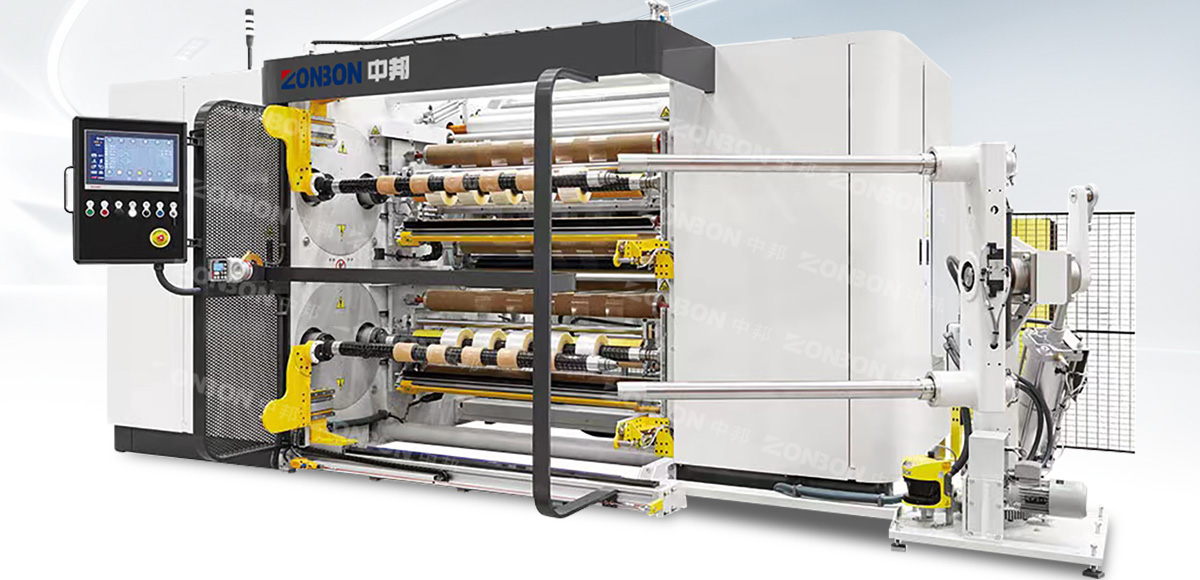
Cutting technology is only one part of a complete slitting process. Web tension, guiding, knife positioning, unwinding, rewinding, roll dimensions, and automation must also work together with the selected razor, shear, or crush cutting system.
Buyers comparing equipment for different roll materials can reviewZONBON Slitting Machinesand evaluate the machine configuration according to the actual material and finished-roll requirements.
For BOPP, PET, PE, CPP, and flexible packaging films, knife selection should be evaluated together with web tension, film stability, slit width, and rewinding requirements. Buyers whose main application is plastic film can also review aFilm Slitting Machineconfiguration when comparing how the cutting system fits into the complete converting process.
Choose the cutting method according to the material, finished edge, production conditions, and downstream process rather than assuming one technology is universally superior.
Razor slitting is commonly worth evaluating for suitable thin flexible films. Shear slitting is widely used when controlled cutting and consistent edges are important across film, paper, and laminate applications. Crush cutting can be practical for selected thicker, fibrous, or compressible materials that respond well to pressure-based separation.
When more than one method appears suitable, compare the actual production result: edge quality, dust, stable speed, knife wear, changeover requirements, maintenance, and finished-roll performance. For unfamiliar or demanding materials, a representative cutting test provides a stronger basis for selection than a general machine specification.
The final decision process can be summarized as:
Material Structure → Finished Product → Required Edge Quality → Production Conditions → Cutting Test When Needed → Razor, Shear or Crush Selection
pre: -
next: -
Zonbon, The Most Professional Flexible Printing and Packaging Converting Machines Manufacturer Around You.
© 2011-2025 Zonbon Printing & Packaging Machinery Co., Ltd. All Rights Reserved