Blogs
We share with you the latest industry trends, try to solve all your questions about flexible packaging machines and printing machines as well. Read our blogs to keep abreast of what’s new in the industry and in Zonbon.

There is no single film slitting machine configuration that is ideal for every plastic film. A machine suitable for high-speed BOPP converting may require different tension, cutting, and rewinding settings from one processing stretchable PE film, dimensionally stable PET, CPP, or multilayer laminated packaging film.
For buyers, the correct starting point is therefore not the maximum machine speed or the number of automatic functions. It is the film you need to process and the finished rolls you need to produce.
Before comparing film slitting machines, buyers should define the film structure, thickness range, parent roll dimensions, required slit widths, finished roll diameter, core size, and expected production output. These requirements determine which cutting method, tension system, rewinding structure, and level of automation are actually useful.
This article explains how BOPP, PET, PE, CPP, and laminated films create different slitting requirements and how global buyers can translate those material requirements into a practical machine configuration.
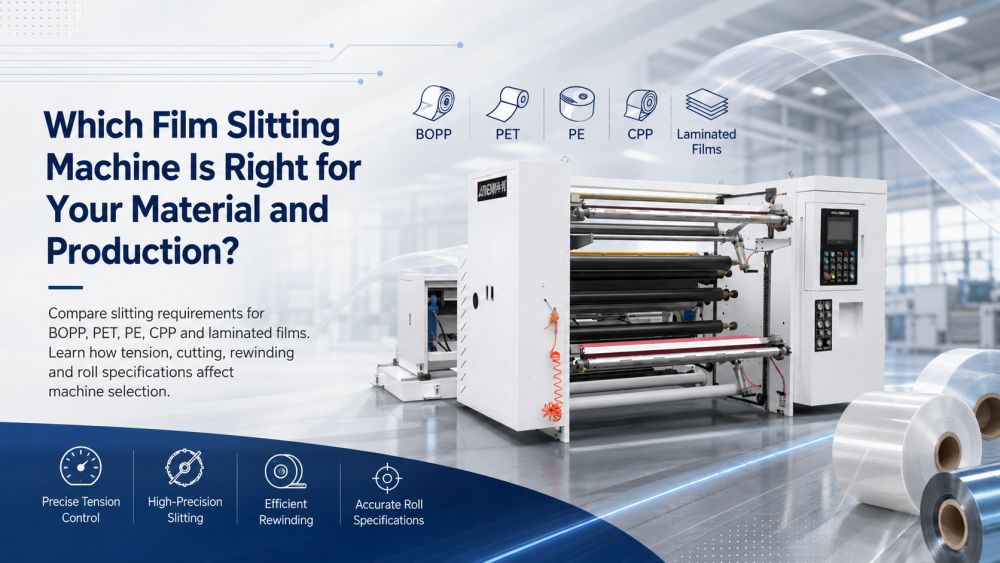
A common mistake when purchasing a film slitting machine is to compare machine specifications before defining the material. Maximum speed, working width, unwind diameter, and automation level are important, but these figures have limited value if the machine cannot maintain stable web handling with the buyer's actual film.
Different films respond differently to tension, acceleration, cutting pressure, and rewinding force. Thin or stretchable films can deform under excessive tension, while thicker laminated structures may require different knife settings and winding conditions.
The first selection question should therefore be:What film will the machine actually slit?
BOPP, PET, PE, CPP, and laminated films may all be processed on film slitting equipment, but their material behavior is different. The following comparison gives buyers a practical starting point when discussing machine configuration with a manufacturer.
| Film Material | Typical Characteristics | Main Slitting Concerns | Machine Selection Focus |
|---|---|---|---|
| BOPP | Thin, widely used packaging film with good dimensional stability | Edge quality, tension stability and consistent high-speed rewinding | Accurate tension control, suitable cutting system and stable rewinding |
| PET | Strong, relatively dimensionally stable film used in printing and lamination | Cutting accuracy, clean edges and roll consistency | Precise knife positioning and controlled rewinding |
| PE | Flexible and more stretch-sensitive than many rigid packaging films | Stretching, wrinkles and tension variation | Stable low-tension control and smooth acceleration/deceleration |
| CPP | Flexible packaging film requiring stable web handling | Web stability, edge quality and winding consistency | Controlled tension and suitable rewinding configuration |
| Laminated Film | Multi-layer structure combining two or more materials | Variable thickness, stiffness, cutting behavior and finished roll quality | Configuration based on the actual laminate structure rather than one material name |
This comparison is a starting point rather than a universal specification. Film thickness, coating, printing, lamination structure, surface characteristics, and finished roll dimensions can change the required machine settings even when two buyers process the same general film type.
BOPP is widely used for flexible packaging, labels, lamination, and other converting applications. Its relatively good dimensional stability makes it suitable for efficient roll-to-roll processing, but high production speeds still require coordinated tension, cutting, and rewinding control.
When evaluating a film slitting machine for BOPP, buyers should pay particular attention to:
Web tension stability: tension should remain controlled as the parent roll diameter decreases.
Cutting edge quality: the knife system should produce consistent edges at the required slit widths.
Rewinding consistency: multiple finished rolls should maintain suitable hardness and alignment.
Operating stability: quoted maximum speed should not be evaluated separately from actual roll quality.
For printed or laminated BOPP, buyers should also consider whether the material has already passed through printing or laminating processes, because unnecessary web deformation or excessive tension can affect downstream converting quality.
PET film is widely used in printed packaging, laminated structures, labels, and industrial applications. Compared with more stretch-sensitive films, PET generally offers good dimensional stability, but accurate slitting and consistent rewinding remain important when narrow finished rolls or demanding downstream processes are involved.
For PET film production, buyers should evaluate:
Knife positioning and slit-width accuracy
Clean and consistent cut edges
Stable tension throughout acceleration and deceleration
Finished roll alignment and hardness consistency
If the PET is printed, coated, metallized, or laminated, the machine configuration should be evaluated using the actual processed structure rather than assuming that all PET rolls behave in the same way.
PE film can be more sensitive to stretching and tension variation than materials such as PET. Excessive or unstable web tension may deform the film, introduce wrinkles, or create inconsistent finished rolls.
For PE film, buyers should therefore focus less on maximum theoretical speed and more on whether the machine can maintain controlled web behavior throughout the complete roll diameter range.
Low and stable tension: helps reduce unnecessary film stretching.
Smooth speed changes: acceleration and deceleration should not create sudden tension fluctuations.
Suitable rewinding pressure: prevents rolls from becoming excessively tight or uneven.
Material-specific testing: thin or highly stretchable PE should ideally be evaluated using representative production material.
CPP film is commonly used in flexible packaging and laminated structures. Reliable CPP slitting depends on maintaining stable web movement while producing finished rolls with consistent edges and winding quality.
Important considerations include:
Film thickness and actual structure
Required slit width
Tension stability
Cutting method
Finished roll diameter and hardness
Buyers processing both CPP and other packaging films should confirm the complete material range with the machine manufacturer rather than selecting the machine around only one standard film.
"Laminated film" does not describe one fixed material. A laminate may combine PET, BOPP, PE, CPP, aluminum foil, metallized film, paper, or other layers. Each structure can have different thickness, stiffness, surface characteristics, and tension behavior.
For this reason, buyers should not simply ask whether a machine can "slit laminated film." A more useful technical discussion should include:
The complete laminate structure
Total material thickness
Whether the material is printed or coated
Parent roll width and diameter
Required finished roll widths
Minimum and maximum rewind diameter
Expected production speed
For example, a PET/PE packaging laminate and an aluminum-foil-based laminate may both be described as flexible packaging materials, but they should not automatically be assumed to require identical tension, cutting, and rewinding settings.
Instead of sending only a message such as "I need a BOPP film slitting machine," buyers can provide a short production specification that allows the supplier to evaluate the application more accurately.
| Information | Example of What to Provide |
|---|---|
| Material | BOPP, PET, PE, CPP or complete laminated structure |
| Thickness | Minimum and maximum thickness range |
| Parent Roll | Maximum width, diameter and approximate weight |
| Finished Rolls | Required slit widths, core size and maximum diameter |
| Production | Expected operating speed and daily output |
| Special Requirements | Printed film, coated film, sensitive surface or other conditions |
Providing these details makes it easier to determine the appropriate cutting technology, tension range, rewinding structure, roll handling system, and automation level before final machine selection.
Once the film type and finished roll requirements are clear, the next step is to match them with the correct machine configuration. For film converting, the most important decisions usually involve the cutting method, tension control, web guiding, rewinding structure, and realistic operating speed.
These systems should be evaluated together. A suitable knife system cannot compensate for unstable tension, and a high-speed drive system provides little benefit if the rewinding section cannot produce consistent finished rolls at that speed.
Razor and shear slitting are two common cutting methods for film converting. The correct choice depends on film thickness, structure, required edge quality, slit width, production speed, and whether the material is a single film or a laminated structure.
| Cutting Method | Typical Strength | Film Applications to Evaluate | Buyer Consideration |
|---|---|---|---|
| Razor Slitting | Simple cutting action and suitable for many thin films | BOPP, PET and other suitable thin plastic films | Confirm film thickness, edge quality and blade suitability |
| Shear Slitting | Controlled scissor-like cutting using upper and lower knives | Films and laminated structures requiring controlled edge quality | Confirm knife setup, material structure and required slit accuracy |
Buyers should avoid choosing a cutting method only because it is described as more advanced. The correct question is whether the cutting system can consistently produce the required edge quality on the actual material at the required production conditions.
If the material is unusually thin, coated, metallized, laminated, or difficult to slit, providing representative film samples before finalizing the machine configuration can reduce selection risk.
A practical material test can help evaluate:
Whether the selected knife system produces clean edges
Whether the film remains stable at the required tension
Whether the required narrow slit width can be maintained
Whether the finished rolls rewind evenly
Whether the film surface remains acceptable after processing
This is particularly useful when a buyer's material structure cannot be fully described by terms such as BOPP, PET, PE, or laminated film alone.
Film tension changes continuously during production. As the parent roll becomes smaller and the finished rewind rolls become larger, the machine must maintain suitable web tension throughout the process.
For thin or stretch-sensitive films, excessive tension can deform the web, while insufficient or unstable tension can cause poor tracking and inconsistent rewinding.
| Production Symptom | Possible Tension-Related Issue | What Buyers Should Evaluate |
|---|---|---|
| Film wrinkles | Uneven or excessive web tension | Tension stability and web handling |
| Film stretching | Tension too high for the material | Low-tension control capability |
| Loose finished rolls | Insufficient rewinding tension | Rewind tension control |
| Telescoping | Unstable winding or tension distribution | Rewinding structure and tension consistency |
| Different roll hardness | Unequal tension between rewind rolls | Individual roll tension compensation |
"Automatic tension control" is useful information, but the term alone does not tell buyers whether the system is suitable for their application. The more important question is how the machine measures, adjusts, and maintains tension with the actual film throughout unwinding, slitting, and rewinding.
When comparing machines, buyers can ask:
How is unwind tension measured and controlled?
Can the machine maintain low tension for thin or stretchable film?
How does tension change as roll diameter changes?
Is rewinding tension independently controlled?
How does the system respond during acceleration and deceleration?
Accurate slitting depends on the film entering the cutting section in a stable position. If the parent roll is not perfectly aligned or the web moves laterally during production, even a precise knife system may not maintain the required slit position.
A web guiding or edge-position control system can correct lateral movement before the material reaches the slitting section.
This becomes especially important when buyers process:
Printed packaging films
Pre-laminated materials
Wide parent rolls
Narrow finished rolls with tight width requirements
Materials that tend to move laterally during unwinding
The unwind section should be selected according to more than maximum web width. Parent roll diameter, roll weight, core size, loading method, and operator handling requirements all affect daily production.
| Parent Roll Information | Why Buyers Should Confirm It |
|---|---|
| Maximum Width | Determines required machine working width |
| Maximum Diameter | Determines unwind capacity and production duration per roll |
| Maximum Weight | Affects shaft, support and loading requirements |
| Core Diameter | Determines compatibility with the unwind holding system |
| Loading Method | Affects operator workload and roll change efficiency |
For a film converter, production is not complete when the film has been cut to the correct width. The finished rolls must also be suitable for storage, transport, printing, laminating, bag making, or other downstream processes.
A buyer should therefore evaluate the rewinding result as carefully as the slitting accuracy.
Important finished roll requirements include:
Consistent roll hardness
Flat and aligned roll edges
Stable core positioning
Controlled winding tension
No excessive wrinkles or telescoping
Repeatable quality between multiple rewind rolls
Differential rewinding can be valuable when several narrow film rolls are rewound simultaneously and small differences in film thickness, tension, or roll diameter would otherwise create uneven winding conditions.
Instead of forcing every finished roll to rotate under exactly the same winding condition, a differential system can compensate for differences between individual rolls and help maintain more consistent tension.
Buyers should consider discussing differential rewinding when:
One parent roll is divided into many narrow finished rolls
Finished roll hardness consistency is important
Small material thickness variations affect winding
High-value packaging films require better roll quality
Standard shaft rewinding has difficulty maintaining equal roll conditions
However, differential rewinding should not be treated as a mandatory feature for every film application. The decision should depend on slit pattern, material characteristics, roll width, and required finished roll quality.
Maximum machine speed is easy to compare on quotation sheets, but it does not necessarily represent the speed a buyer can maintain with a specific film and finished roll specification.
A machine rated for a high maximum speed may need to operate slower when processing thin stretchable film, very narrow slit widths, sensitive printed materials, difficult laminate structures, or demanding finished rolls.
When comparing suppliers, buyers should distinguish between maximum mechanical speed and stable production speed under actual operating conditions.
| Factor | Why It Can Affect Actual Speed |
|---|---|
| Film Thickness | Thin or sensitive materials may require more controlled tension and acceleration |
| Slit Width | Very narrow rolls can place greater demands on cutting and rewinding stability |
| Number of Rewind Rolls | More finished rolls can increase rewinding control requirements |
| Parent Roll Size | Large diameter and weight influence unwind dynamics and handling |
| Finished Roll Quality | Higher winding requirements may limit practical operating speed |
| Material Structure | Printed, coated or laminated films may require different operating conditions |
Instead of comparing two quotations line by line based only on headline specifications, buyers can evaluate whether each machine configuration solves the same production requirements.
| Don't Compare Only... | Also Ask... |
|---|---|
| Maximum speed | What stable speed can be achieved with my actual film? |
| Maximum working width | Can the machine handle my parent roll diameter and weight? |
| Automatic tension control | How is tension measured and adjusted throughout the roll? |
| Knife type | Has this cutting method been selected for my film structure and thickness? |
| Rewind diameter | Can the machine maintain the required roll hardness and edge quality? |
| Servo control | Which machine functions are servo-controlled and what production problem does that solve? |
This approach makes quotation comparison more meaningful because it connects each machine specification with an actual production requirement.
A technical specification sheet is useful only when each parameter is connected to the buyer's actual production requirement. Two film slitting machines may show similar working widths and speeds while delivering very different results with the same material.
Instead of asking which machine has the highest specification, buyers should determine whether the quoted specifications cover their actual film range, parent rolls, slit patterns, finished rolls, and production conditions.
| Specification | Don't Just Ask | Also Confirm |
|---|---|---|
| Working Width | What is the maximum web width? | Can it cover all current and planned parent roll widths? |
| Unwind Diameter | What is the maximum diameter? | What roll weight can the unwind safely handle? |
| Machine Speed | What is the maximum speed? | What stable speed is realistic with the actual film and slit pattern? |
| Minimum Slit Width | What is the smallest possible width? | Can the required width be maintained consistently under production conditions? |
| Film Thickness | What thickness range is listed? | Has the tension and cutting configuration been matched to both the thinnest and thickest materials? |
| Rewind Diameter | What is the maximum finished diameter? | Can roll hardness and edge alignment remain consistent as diameter increases? |
| Core Diameter | Which core sizes are supported? | Does the machine support all cores used by your customers or downstream equipment? |
| Slitting Accuracy | What accuracy is quoted? | Under what film, speed, width, and winding conditions was that result achieved? |
Even when two companies process similar films, they may require different machine configurations because the finished products and downstream processes are different. Buyers should therefore describe the complete converting application rather than only naming the raw material.
| Production Scenario | Main Production Challenge | Configuration Focus |
|---|---|---|
| Printed BOPP Packaging Film | Maintaining stable web handling without damaging printed material | Accurate guiding, stable tension and controlled rewinding |
| PET Laminated Packaging Film | Consistent slit edges and finished roll quality | Suitable cutting system, precise positioning and stable rewinding |
| Stretchable PE Film | Preventing unnecessary stretching and wrinkles | Low and stable tension with smooth speed changes |
| CPP Packaging Film | Maintaining web and winding stability | Coordinated tension, cutting and rewinding control |
| Multi-Layer Laminated Film | Different stiffness, thickness and cutting behavior | Configuration based on the complete laminate structure |
| Multiple Narrow Finished Rolls | Maintaining consistent tension and hardness between rolls | Evaluate differential rewinding and individual roll compensation |
| High-Volume Flexible Packaging | Combining output with repeatable finished roll quality | Stable production speed, automation and efficient roll handling |
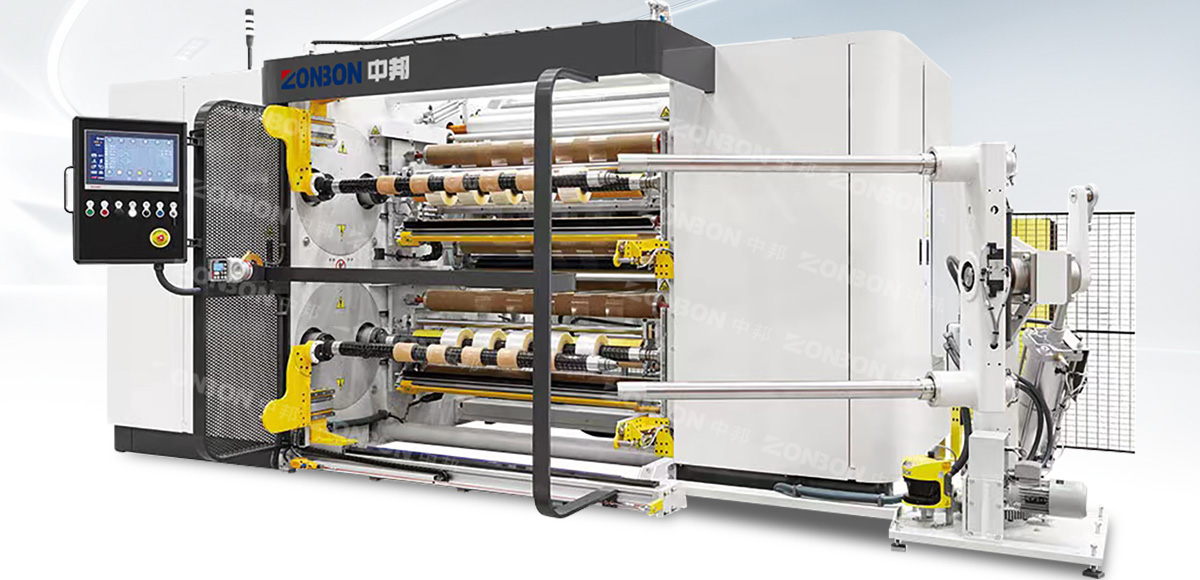
For buyers comparing equipment for BOPP, PET, PE, CPP, laminated films, and other flexible packaging materials, a dedicatedFilm Slitting Machinecan be evaluated according to the actual film thickness, parent roll dimensions, required slit widths, rewinding specifications, and production conditions rather than material type alone.
More automation is not automatically the better choice for every converter. The useful level of automation depends on production volume, parent roll size, order frequency, roll-change requirements, operator availability, and the number of product specifications produced each day.
Buyers should identify where operators currently spend time and where production interruptions occur before deciding which automatic functions provide practical value.
| Function | When It Becomes More Valuable |
|---|---|
| Automatic Web Guiding | Printed films, wide rolls or applications requiring consistent slit position |
| Automatic Tension Control | Thin, stretch-sensitive or demanding packaging films |
| Automatic Roll Loading | Heavy parent rolls and frequent material changes |
| Automatic Knife Positioning | Frequent order changes with many different slit widths |
| Automatic Finished Roll Unloading | Large or heavy rewind rolls and high daily production volume |
| Recipe / Parameter Storage | Repeated production orders using multiple film specifications |
For buyers processing a limited number of standard products, some advanced automatic functions may provide little practical benefit. For converters with frequent job changes and high production volumes, however, automation can reduce manual handling and improve repeatability.
Under-specifying a film slitting machine can restrict production, but over-specifying it can also create unnecessary complexity. Buyers do not need every available function if those functions do not solve a real production requirement.
Before adding an optional configuration, ask three questions:
What production problem does this function solve?
How often will we actually use it?
Will it improve quality, output, changeover efficiency, safety, or labor requirements?
This approach helps separate useful production functions from specifications that look impressive on a quotation but provide limited value in daily operation.
For demanding materials or customized configurations, a machine test using representative production film can provide more useful information than specifications alone. The test should reproduce the buyer's real production requirements as closely as practical.
Instead of simply confirming that the machine can run, buyers should evaluate the complete result from parent roll feeding to finished roll quality.
Whenever possible, the test material should represent the films that will actually be processed after installation. If several materials are important to production, buyers should prioritize the most demanding or highest-volume applications.
Useful information to provide with the sample includes:
Film structure and thickness
Parent roll dimensions
Required slit pattern
Finished roll dimensions
Core diameter
Target operating conditions
Finished roll inspection should go beyond confirming the slit width. Buyers should look for changes that may indicate unsuitable cutting, tension, guiding, or rewinding conditions.
Wrinkles or film deformation
Damaged or inconsistent slit edges
Surface scratching
Loose or excessively tight winding
Telescoping
Uneven finished roll edges
If slit-width accuracy is important to the final product, finished rolls should be measured rather than evaluated visually. Buyers should confirm that the required width can be reproduced consistently across the relevant rolls and production conditions.
When one parent roll is divided into several finished rolls, compare roll hardness, edge alignment, diameter, and overall appearance between positions. Large differences can indicate that the rewinding configuration requires further adjustment.
A useful machine test should not evaluate only a short period at constant speed. Buyers should also observe web stability during acceleration and deceleration because tension fluctuations can become more visible during speed changes.
A factory acceptance test is more valuable when it verifies agreed production requirements rather than simply demonstrating that the machine starts, runs, and rewinds material.
Before the FAT, buyers and suppliers can agree on a practical test checklist covering the most important production conditions.
| FAT Item | What to Verify |
|---|---|
| Material | Run the agreed film or a representative equivalent |
| Slit Pattern | Produce the required finished roll widths |
| Web Stability | Observe guiding and tension during speed changes |
| Cutting Result | Inspect slit edges and width consistency |
| Rewinding | Check roll hardness, edges and winding stability |
| Operating Functions | Verify the agreed automatic and control functions |
| Safety | Confirm guards, emergency stops and relevant safety functions |
The exact FAT criteria should reflect the agreed machine configuration and the buyer's actual production requirements. This makes acceptance more objective and reduces misunderstandings before shipment.
Before finalizing a film slitting machine, buyers should be able to answer the following questions. If several items remain unclear, the machine configuration may not yet be ready for final confirmation.
| Buying Question | Confirm |
|---|---|
| Have all film materials and laminate structures been defined? | ☐ |
| Is the minimum and maximum material thickness known? | ☐ |
| Are parent roll width, diameter, weight and core size confirmed? | ☐ |
| Are minimum and typical finished slit widths confirmed? | ☐ |
| Has the cutting method been matched to the actual film? | ☐ |
| Can the tension system handle the most sensitive film? | ☐ |
| Are finished roll diameter, core and hardness requirements defined? | ☐ |
| Is differential rewinding necessary for the intended slit pattern? | ☐ |
| Has realistic production speed been discussed instead of only maximum speed? | ☐ |
| Are required automatic functions linked to actual production needs? | ☐ |
| Have representative film samples been tested when necessary? | ☐ |
| Have FAT requirements been agreed before machine completion? | ☐ |
The most reliable way to select a film slitting machine is to work from the production requirement backward. Instead of selecting a model first and trying to fit the application around it, define the film and finished roll requirements first and then determine the necessary machine functions.
| Buyer Requirement | Machine Decision |
|---|---|
| Film type and structure | Cutting method and web handling strategy |
| Film thickness and stretch behavior | Tension control range and response |
| Parent roll dimensions | Working width, unwind structure and roll loading |
| Required slit widths | Knife configuration and positioning requirements |
| Number of finished rolls | Rewinding structure and possible differential control |
| Finished roll specifications | Rewind diameter, core compatibility and winding control |
| Daily production pattern | Operating speed and automation level |
This selection process helps buyers compare film slitting machines according to actual production capability rather than relying on isolated specifications or the longest list of optional functions.
The following questions address practical details that buyers often need to confirm when selecting a film slitting machine for flexible packaging and other roll-film converting applications.
Yes, one properly configured film slitting machine can often process BOPP, PET, PE, CPP, and selected laminated films, but the same settings should not be used for every material. The machine must provide a suitable tension range, cutting system, web handling, and rewinding control for the complete film range. Buyers should therefore provide the minimum and maximum thickness and actual material structures before configuration is finalized.
There is no universal minimum slit width for every film slitting machine. The practical limit depends on the machine design, knife arrangement, film thickness, material behavior, rewind shaft configuration, and required roll quality. Buyers should specify their narrowest regular product and ask the manufacturer to confirm that width under representative production conditions rather than relying only on a catalog minimum.
Yes, testing is recommended when printed film is sensitive, high-value, unusually thin, or difficult to rewind. A representative sample can help verify web guiding, surface handling, tension stability, cutting quality, and finished roll appearance. Buyers should also identify any surface that must avoid scratching or excessive roller contact before the machine configuration is finalized.
Often yes, provided the machine's tension, cutting, and rewinding ranges cover both material structures. However, a single-layer PE film and a thicker PET/PE laminate can behave very differently during slitting. Buyers should provide the complete range of structures and thicknesses so the manufacturer can evaluate whether one configuration can process them reliably.
Choose speed according to stable production requirements rather than the highest number on the specification sheet. Film thickness, slit width, number of finished rolls, parent roll size, tension sensitivity, and required rewind quality can all limit practical operating speed. Buyers should ask what speed can be maintained with their representative film while still meeting agreed finished-roll requirements.
Differential rewinding is particularly useful when one parent roll is slit into multiple narrow rolls and small thickness or diameter differences create unequal winding tension. It can help compensate between individual rewind rolls and improve roll consistency. It is not mandatory for every application, so the decision should be based on slit pattern, material behavior, roll width, and required winding quality.
Buyers should confirm both parent-roll and finished-roll core sizes before ordering because they affect the unwind and rewind holding systems. If different customers require multiple finished core sizes, include all regularly used specifications during machine selection. It is also useful to confirm whether changing between core sizes requires additional shafts, adapters, or other components.
Send samples that represent the most important and most difficult production conditions, not only the easiest film to process. Useful samples may include the thinnest film, most stretch-sensitive material, important laminate structure, narrowest slit pattern, or highest-value printed film. Each sample should be accompanied by thickness, roll dimensions, target slit widths, core size, and finished-roll requirements.
Film waste can be reduced through accurate web guiding, correct knife positioning, stable tension, suitable trim-width planning, and consistent roll handling. Buyers should also consider the relationship between parent-roll width and finished slit patterns before production. A fast machine will not necessarily reduce waste if setup, alignment, or cutting consistency is poor.
After installation, verify machine leveling, electrical and pneumatic connections, unwind and rewind alignment, safety functions, knife setup, web guiding, tension settings, and agreed automatic functions. Initial production should use familiar film specifications so operators can compare slit width, edge quality, roll hardness, alignment, and web stability against the results agreed during testing or FAT.
The right film slitting machine is the one that can process your actual material range and produce your required finished rolls consistently. There is no need to select the highest speed, widest machine, or longest list of automatic functions if those specifications do not match the production task.
A practical buying decision can be reduced to five questions:
What films will you process? Define BOPP, PET, PE, CPP, laminated structures, thickness ranges, and any printed or coated surfaces.
What parent rolls will enter the machine? Confirm width, diameter, weight, and core size.
What finished rolls must be produced? Define slit widths, number of rolls, rewind diameter, cores, and required winding quality.
Which machine functions are required to achieve that result? Match cutting, tension, guiding, rewinding, and automation to the application.
Can the proposed configuration demonstrate the required result? Use material testing and FAT when the application requires additional verification.
Following this sequence makes it easier to compare different machines based on production capability rather than isolated specifications.
Film is only one of the roll materials that may require slitting and rewinding. Different applications can require different machine structures, cutting technologies, tension ranges, and finished-roll configurations.
Buyers evaluating film or other roll-material converting equipment can exploreZONBON Slitting Machinesand compare available solutions according to material type and production requirements.
Selecting a film slitting machine should begin with the material and finished product, not with a machine model. BOPP, PET, PE, CPP, and laminated films can create different requirements for tension control, cutting, web guiding, rewinding, and practical production speed.
For global buyers, the most useful comparison is therefore not which supplier offers the largest specification numbers, but which proposed configuration can reliably convert the required films into consistent finished rolls under real production conditions.
Define the material range, parent roll, slit pattern, finished roll, and production target first. Then evaluate the machine configuration against those requirements and verify demanding applications through representative material testing where necessary.
Prepare your film structure, thickness range, parent roll dimensions, required slit widths, finished roll diameter, core size, and expected production conditions. These details provide a practical basis for evaluating the cutting, tension, rewinding, and automation configuration required for your application.
Discuss Your Film Slitting Requirementspre: -
next: -
Zonbon, The Most Professional Flexible Printing and Packaging Converting Machines Manufacturer Around You.
© 2011-2025 Zonbon Printing & Packaging Machinery Co., Ltd. All Rights Reserved