Blogs
We share with you the latest industry trends, try to solve all your questions about flexible packaging machines and printing machines as well. Read our blogs to keep abreast of what’s new in the industry and in Zonbon.

The definition, calculation method, and multidimensional impact of Blown-Up Ratio (BUR) on film properties in plastic film blowing processes are systematically analyzed. By investigating the relationships between BUR and molecular orientation, mechanical properties, optical characteristics, and thickness uniformity, this study establishes scientific foundations for optimizing process parameters. The paper details online measurement technologies and control strategies, while exploring selection principles for BUR under different material systems. These findings provide theoretical guidance and technical references for precise control of film blowing processes.
The blow-up ratio (BUR) is a critical parameter in the film blowing process. It is defined as the ratio of the final diameter of the blown film tube to the diameter of the die from which the film is extruded. Mathematically, it can be expressed as:
BUR = (Final Diameter of Film Tube) / (Die Diameter)
This ratio helps in determining how much the film has expanded during the blowing process, which in turn affects its mechanical and physical properties.
The blow-up ratio is crucial because it influences several aspects of the film, including its thickness, strength, clarity, and orientation. By controlling the BUR, manufacturers can tailor the film’s properties to meet specific requirements for various applications. For instance, a higher BUR typically results in better film orientation, which can enhance the film’s strength and clarity.
Calculating the blow-up ratio involves measuring the final diameter of the film tube and the diameter of the die. Here are the steps:
Measure the final diameter of the blown film tube using a caliper or any suitable measuring tool.
Measure the diameter of the die used in the extrusion process.
Divide the final diameter of the film tube by the die diameter to obtain the blow-up ratio.
For example, if the final diameter of the film tube is 30 cm and the die diameter is 10 cm, the BUR would be:
BUR = 30 cm / 10 cm = 3.0
To simplify the calculation, you can use a Blow Up Ratio Calculator. This tool allows you to input the final diameter of the film tube and the die diameter to automatically calculate the BUR. It’s a convenient way to quickly determine the blow-up ratio without manual calculations.
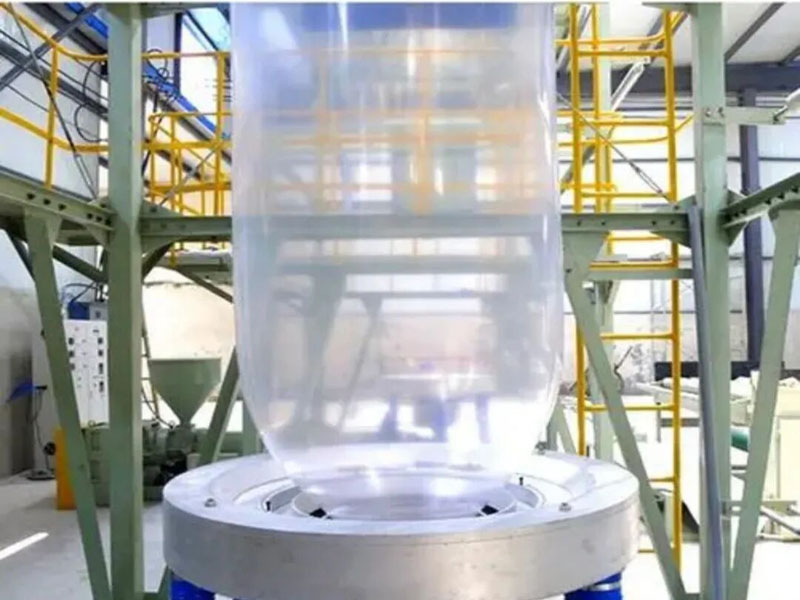
The process of blowing the film stretches the polymer chains in two primary directions: the machine direction (MD), which is the direction the film is pulled, and the transverse direction (TD), which is across the width of the film. The blow-up ratio is the primary factor that determines the balance of orientation between these two directions.
Blow-Up Ratio | Effect on Molecular Orientation & Film Properties |
Low BUR | - Predominant orientation in the machine direction (MD). |
High BUR | - Greater orientation in the transverse direction (TD). |
The "Securely Sealed Bag" Problem: The issue of bags that are not sealed securely often stems from a significant imbalance in the film's tensile properties. If the film has a very high MD strength and a very low TD strength (a result of a low BUR), the heat-sealing process can be compromised. The weaker TD direction may not have the integrity to form a strong, reliable seal, or it may be prone to splitting near the seal when under stress. Achieving a more balanced film by optimizing the BUR is crucial for applications requiring strong seals.
Beyond tensile strength, the blow-up ratio impacts several other critical film attributes:
Impact Strength: Generally, a higher BUR can lead to improved impact strength, as the biaxial orientation of the polymer chains creates a more robust structure that can better absorb and distribute impact forces.
Optical Properties: Increasing the BUR often enhances the film's clarity and reduces haze. The stretching of the film in two directions can lead to a smoother surface and a more uniform internal structure.
Film Thickness and Uniformity: While the final film thickness is also controlled by the extrusion speed and take-up rate, the BUR plays a role. A higher BUR will naturally result in a thinner film for a given die gap and output. Maintaining a stable bubble, which is directly related to the BUR, is also essential for achieving uniform thickness across the film's width.
To achieve the best results in the film blowing process, consider the following best practices:
Regularly monitor and adjust the blow-up ratio to maintain consistent film quality.
Use a Blow Up Ratio Calculator to ensure accurate calculations.
Experiment with different BUR settings to find the optimal ratio for your specific film requirements.
Maintain proper temperature control during the extrusion process to ensure uniform film expansion.
The ideal BUR is not a one-size-fits-all number; it is highly dependent on the type of polymer being processed due to its unique molecular structure and melt characteristics. Here are some general guidelines:
· Low-Density Polyethylene (LDPE): Typically runs at a BUR of 2:1 to 4:1. LDPE is quite forgiving and produces a stable bubble over a relatively wide range of ratios.
· Linear Low-Density Polyethylene (LLDPE): Often processed in a similar range to LDPE, from 2:1 to 4:1. Achieving the optimal BUR is key to maximizing LLDPE's renowned toughness and puncture resistance.
· High-Density Polyethylene (HDPE): Requires a higher BUR, often in the range of 3:1 to 6:1, especially for high molecular weight (HMW) grades. The higher ratio is necessary to achieve a good balance of stiffness and tear resistance.
The ideal blow-up ratio for packaging films typically ranges from 2.0 to 4.0, depending on the desired film properties and application requirements. Experimentation and optimization may be necessary to determine the best BUR for specific needs.
A higher blow-up ratio generally improves film clarity by enhancing biaxial orientation. This results in a more uniform and transparent film, which is desirable for applications requiring high visibility and aesthetic appeal.
Yes, the blow-up ratio can be adjusted during the film blowing process by modifying the air pressure and extrusion speed. However, it is essential to monitor the changes closely to maintain consistent film quality.
Tools like the Blow Up Ratio Calculator are useful for accurately calculating the blow-up ratio. These tools simplify the process and ensure precise measurements.
Controlling the blow-up ratio is important because it directly affects the film’s properties, such as thickness, strength, and clarity. Proper control ensures that the film meets the desired specifications and performs effectively in its intended application.
The blow-up ratio is far more than just a simple calculation; it is a cornerstone of the film blowing process. By understanding and controlling the BUR, operators can move from being at the mercy of their machinery to being in command of their film quality. Knowing your die size is only the first step. The ability to manipulate the BUR to achieve the desired film width and, more critically, the optimal balance of mechanical properties, is what separates inconsistent output from high-quality, reliable film production. The next time a bag seal fails, a closer look at the blow-up ratio may just provide the answer.
pre: -
next: -

Zonbon, The Most Professional Flexible Printing and Packaging Converting Machines Manufacturer Around You.
© 2011-2025 Zonbon Printing & Packaging Machinery Co., Ltd. All Rights Reserved